


Why Do SPC Flooring Become Brittle After Long-Term Storage?
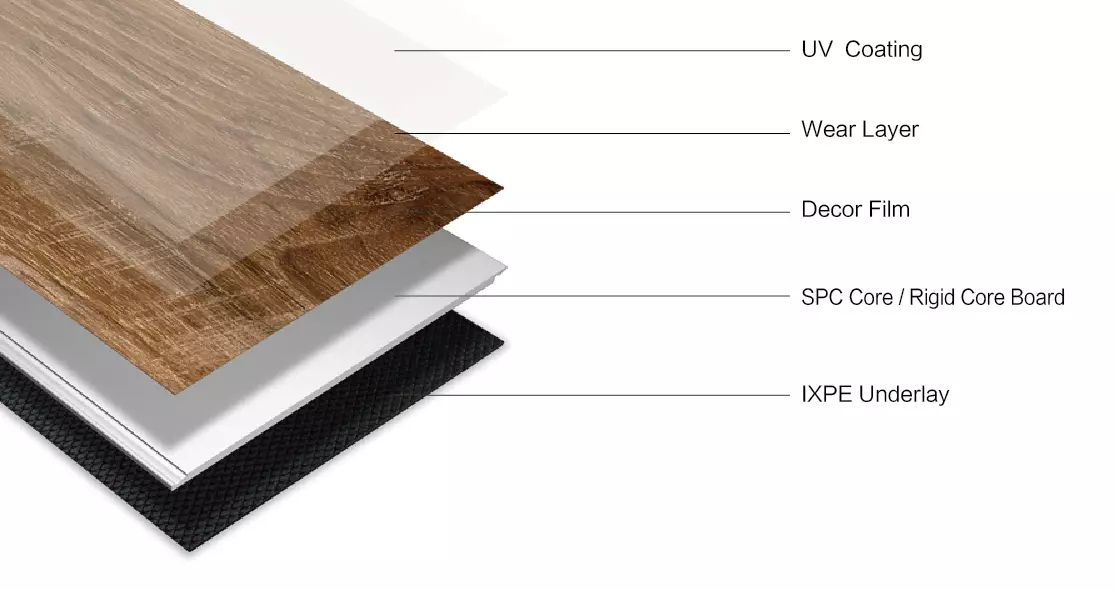
A customer recently shared an interesting case with us.
A batch of SPC flooring had been stored for about 14 months. When the end customer started cutting and installing the flooring, they found serious problems: edge chipping and brittle fracture during cutting.
The COA report showed that all properties were qualified before shipment. The distributor also stored the products under normal warehouse conditions, without direct sunlight or rain exposure.
At that moment, nobody could clearly define the responsibility. Both sides felt disappointed.
However, this type of problem is not uncommon in the SPC flooring industry.
Some SPC boards can be flexible and easy to cut when they are newly produced, but after long-term storage, they may become much more brittle and break easily.
So, what causes this phenomenon?
1. SPC Formula: A High-Filled Composite System
SPC flooring is a typical high-filled PVC composite material.
A common SPC formulation may include:
- PVC resin: 100 phr -> The main polymer structure
- Calcium carbonate: 300-350 phr -> Reduces cost and increases stiffness
- Ca-Zn stabilizer: 1-10 phr -> Protects PVC from thermal degradation
- Internal lubricants (G60 / Stearic acid): 1-5 phr -> Improve fusion and reduce molecular friction
- External lubricants (PE wax): 1-5 phr -> Reduce friction between melt and processing equipment
- CPE impact modifier: 1-10 phr -> Improve toughness and impact resistance
- ACR processing aid: 1-10 phr -> Improve fusion and melt strength
- Recycled SPC material: 50-150 phr -> Reduce production cost
This is an extreme example of high-filled system.
The amount of calcium carbonate can be more than three times the amount of PVC resin.
Therefore, the bonding quality between calcium carbonate particles and PVC matrix plays a critical role in determining the final toughness of SPC flooring.
If the interface becomes weak, calcium carbonate particles can change from a reinforcing filler into stress concentration points, where cracks start to form.
2. Internal Lubricants: Helpful During Processing, But Need Balance
Internal lubricants such as G60 and stearic acid play an important role during SPC extrusion.
At high processing temperatures, they are compatible with PVC and help:
- Improve PVC fusion
- Reduce molecular friction
- Achieve more uniform processing
However, the behavior of lubricants changes with temperature.
During extrusion:
- High temperature stage -> Better compatibility with PVC -> Internal lubrication effect
During cooling and storage:
- Compatibility decreases -> Some lubricant molecules may gradually migrate
When SPC boards cool down from around 190°C processing temperature to room temperature, part of the internal lubricant may slowly move inside the PVC structure.
This migration can sometimes cause surface blooming, where a white powdery or oily layer appears on the surface.
But the more important issue is not only the visible blooming.
3. The Hidden Risk: Weakening the PVC-Calcium Carbonate Interface
In a highly filled SPC system, calcium carbonate particles need strong bonding with PVC resin.
During long-term storage, some lubricant molecules may accumulate around the interface between calcium carbonate and PVC.
This creates a very thin lubricating layer between the filler and polymer.
Originally:
PVC + Calcium carbonate -> Strong interaction -> Good stress transfer -> Better toughness
After interface lubrication:
PVC + Lubricant layer + Calcium carbonate -> Reduced bonding -> Poor stress transfer -> Easier crack formation
Microscopically, this weak interface works like a small "separation layer".
When the flooring is cut or impacted, stress cannot transfer effectively through the material, and cracks can quickly develop around calcium carbonate particles.
4. Temperature Changes Can Accelerate the Problem
Warehouse temperature changes can also influence this process.
For example:
- Summer: 35°C or higher
- Winter: Below 10°C
Repeated temperature cycles may accelerate the movement of lubricant molecules inside the PVC structure and gradually weaken the interface between PVC and fillers.
Conclusion
The brittleness of SPC flooring after long-term storage is not always caused by obvious storage problems.
In highly filled PVC systems, the balance of:
- PVC resin
- Calcium carbonate
- Internal lubricants
- External lubricants
- Processing aids
- Recycled materials
is extremely important.
A proper lubricant balance can ensure good processing performance while maintaining long-term mechanical properties. In SPC production, processing stability and long-term durability must be considered together.
In highly filled SPC formulations, improving the PVC-CaCO3 interface is critical. This can be achieved through proper calcium carbonate surface treatment, adding coupling agents, optimized lubricant balance, and sufficient plasticization.
Contact Novista for detailed solutions!