


PVC Profile Extrusion: Vacuum Calibration vs. Hard Die Forming – Process Principles and Key Differences
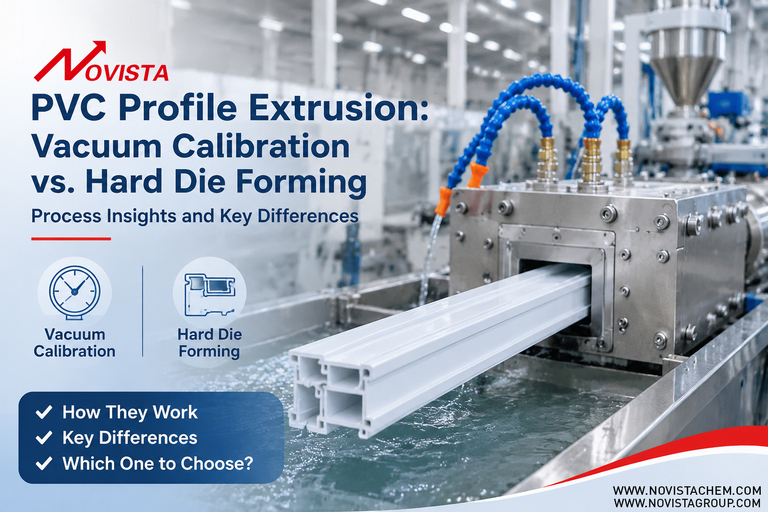
In PVC profile extrusion, product quality depends not only on the formulation and extrusion equipment, but also on the calibration process.
Two different calibration methods are used in PVC profile production: Vacuum Calibration and Hard Die Forming (Non-vacuum Calibration).
Although both methods are used to control the final shape and dimensions of PVC profiles, they work in different ways and have different production characteristics.
In this article, we will look at how these two methods work, their main features, and how they affect PVC formulation design.
Vacuum Calibration
1.1 How Does It Work?
Vacuum calibration is a widely used method in PVC profile extrusion.
After the PVC material is melted and plasticized in the extruder, it passes through the extrusion die to form the initial profile shape.
The hot profile then enters the vacuum calibration unit.
Inside the calibration unit, a vacuum system creates negative pressure, helping the hot PVC profile fit closely against the inner surface of the calibration tooling.
At the same time, a cooling system removes heat from the profile, helping it maintain the required dimensions and shape.
The profile then passes through further cooling and pulling processes before becoming the finished product.
1.2 Main Features
Higher Production Speed Potential
Vacuum calibration helps the profile fit closely against the calibration tooling. When combined with an effective cooling system and properly designed equipment, it can support relatively high extrusion speeds.
Requirements for Material Processing Performance
The PVC compound needs suitable plasticization and melt strength to maintain a stable profile shape during calibration and pulling.
Wide Applications
Vacuum calibration is widely used for PVC window and door profiles, decorative profiles, and other PVC extruded profiles.
Hard Die Forming (Non-vacuum Calibration)
2.1 How Does It Work?
Hard die forming is another method used in PVC profile calibration.
After melting and plasticization in the extruder, the PVC material passes through the extrusion die to obtain its initial cross-sectional shape.
The hot profile then enters a specially designed calibration die.
Unlike vacuum calibration, this method does not rely on negative pressure to pull the profile against the calibration tooling.
Instead, the profile is shaped mainly by the mechanical constraints of the calibration die, together with cooling.
After calibration, the profile continues through the cooling and pulling sections to complete the production process.
2.2 Main Features
Good Surface Gloss Potential
Hard die forming can be used for PVC profiles that require a high-gloss surface and good appearance.
With suitable die design, formulation, and processing conditions, it can help achieve a smooth and glossy surface.
For example, some PVC decorative profiles used inside refrigerators and freezers require good surface quality and appearance.
Suitable for Some Highly Filled PVC Formulations
Hard die forming can be used with certain PVC formulations containing relatively high levels of fillers, such as calcium carbonate (CaCO3).
This may help manufacturers increase filler content and reduce raw material costs.
However, increasing the filler level also changes the flow behavior, plasticization, and final properties of the PVC compound.
Therefore, the stabilizer, lubricant, and processing aid systems need to be adjusted according to the actual formulation and product requirements.
Production Speed Depends on Calibration and Cooling Conditions
Compared with vacuum calibration, some hard die forming processes may be limited by die design, cooling efficiency, and profile geometry.
However, production speed cannot be determined by the calibration method alone. Actual performance depends on the equipment, tooling, formulation, and processing conditions.
Main Differences Between the Two Methods
The main difference lies in how the PVC profile is calibrated and shaped.
Comparison:
Calibration Principle
Vacuum Calibration: Negative pressure helps the profile fit against the calibration tooling.
Hard Die Forming: Mechanical constraints of the calibration die.
Vacuum System
Vacuum Calibration: Required.
Hard Die Forming: Not required.
Cooling
Vacuum Calibration: Cooling system.
Hard Die Forming: Cooling system.
Production Speed
Vacuum Calibration: Good potential for relatively high speeds.
Hard Die Forming: May be limited by cooling and calibration conditions.
Surface Quality
Vacuum Calibration: Depends on tooling, formulation, and processing conditions.
Hard Die Forming: Can be used for products requiring high surface gloss.
Filler Content
Vacuum Calibration: Depends on formulation and product requirements.
Hard Die Forming: Suitable for some highly filled formulations.
Typical Applications
Vacuum Calibration: PVC window profiles, decorative profiles, and other extruded profiles.
Hard Die Forming: Selected high-gloss and highly filled PVC profiles.
These are general process characteristics. Neither method is automatically better under all production conditions.
How Do Different Calibration Methods Affect PVC Formulation Design?
For PVC profile manufacturers, choosing a calibration method is not only a matter of equipment selection. The PVC formulation must also match the processing conditions.
Several additives play important roles in the extrusion process.
Calcium-Zinc Stabilizers (Ca-Zn Stabilizers)
Ca-Zn stabilizers provide thermal stability during PVC processing.
They also need to maintain a suitable balance with the lubrication system to support proper plasticization and stable extrusion.
The stabilizer formulation should be selected according to processing temperature, residence time, extrusion speed, and other formulation components.
Acrylic Processing Aids (ACR Processing Aids)
ACR processing aids help improve PVC fusion and melt strength.
For different calibration processes, manufacturers should pay attention to plasticization speed, melt uniformity, and dimensional stability during calibration.
Impact Modifiers
Impact modifiers improve the toughness and impact resistance of PVC products.
For highly filled formulations, increasing the filler content may affect the impact performance of the finished product.
The formulation should therefore be adjusted to achieve the required balance between filler loading, toughness, and other product properties.
Lubricants
The balance between internal and external lubricants affects PVC plasticization, melt flow, die release, and surface quality.
Different extrusion equipment, dies, and calibration conditions may require different lubricant balances.
An unsuitable lubrication system may lead to poor plasticization, rough surfaces, or plate-out.
Conclusion
Vacuum calibration and hard die forming are two different methods used in PVC profile extrusion.
Vacuum calibration uses negative pressure to help the hot profile fit against the calibration tooling. Combined with an effective cooling system, it is widely used in continuous PVC profile production and offers good potential for relatively high extrusion speeds.
Hard die forming relies mainly on the mechanical constraints of the calibration die and cooling. It can be used for selected PVC profiles that require good surface gloss or relatively high filler content.
In actual production, product quality, filler loading, and production speed cannot be determined by the calibration method alone.
Proper die design, PVC formulation, processing conditions, and cooling systems must work together to achieve the required product performance.
NOVISTA provides a complete range of solutions for rigid PVC applications, including impact modifiers, processing aids, lubricants, and calcium-zinc stabilizers for PVC profiles.
Our additive solutions help maintain thermal stability during processing while supporting proper plasticization and sufficient melt strength. They are suitable for applications using both vacuum and non-vacuum calibration, helping manufacturers achieve better product performance and surface appearance.