


Elongation at Break ≠ Toughness: 3 Misconceptions Every Plastics Compounder Should Understand
A customer looks at a datasheet and asks:
"What's the real difference between 15% and 300% elongation at break? Does higher elongation always mean better toughness?"
This is a common question in plastics compounding and processing.
Many people tend to associate elongation at break with impact resistance, toughness, or elasticity. However, these properties describe different aspects of material behavior.
Let's clear up three common misconceptions.
What Is Elongation at Break?
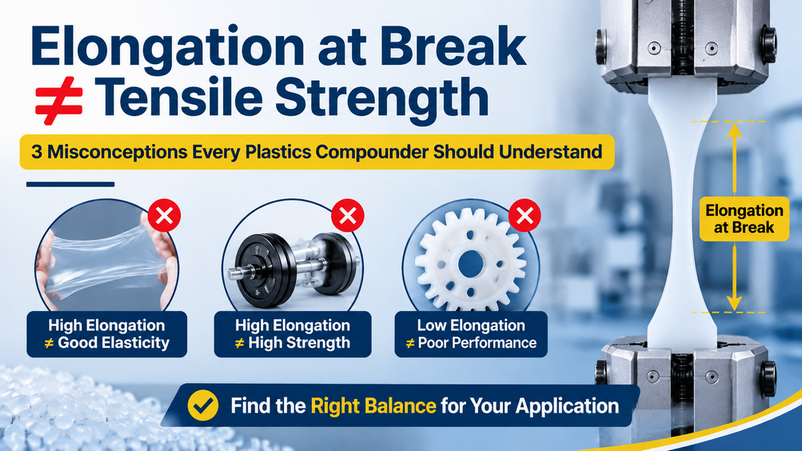
Imagine clamping a standard dumbbell-shaped specimen in a tensile testing machine and pulling it until it fractures.
Elongation at break is the percentage increase in the specimen's gauge length at the moment of fracture, compared with its original gauge length.
In simple terms, it tells us how much a material can stretch before breaking.
It is an important indicator of ductility and deformation capacity, but it does not tell the whole story about mechanical performance.
Three Common Misconceptions
Misconception 1: High elongation = good elasticity
Not necessarily.
Elasticity refers to a material's ability to recover its original shape after the applied load is removed.
High elongation, on the other hand, often involves permanent plastic deformation.
For example, film-grade LDPE can achieve elongation at break of 500% or even higher. However, once stretched beyond its elastic range, it undergoes permanent deformation rather than returning to its original dimensions.
Misconception 2: High elongation = high tensile strength
Strength and elongation are often competing properties in material design.
For example, unfilled PP typically has tensile strength around 30 MPa, with elongation depending heavily on the grade and test conditions.
When 30% glass fiber is added, tensile strength can increase significantly, potentially exceeding 80 MPa, while elongation at break may drop to just 3-5%.
The material becomes stronger and stiffer, but much less ductile.
Misconception 3: Low elongation = poor material performance
Absolutely not.
Many structural engineering plastics and fiber-reinforced compounds have relatively low elongation at break, sometimes below 10%.
Yet they can deliver excellent stiffness, dimensional stability, and load-bearing performance.
The key is whether the material meets the mechanical requirements of its intended application.
Why Does Elongation at Break Suddenly Drop in Compounding?
In formulation development, a significant reduction in elongation can often point to problems with raw materials, additive balance, or processing conditions.
Here are three common causes:
Filler agglomeration and poor surface treatment
Coarse calcium carbonate or talc, as well as insufficient filler surface treatment, can create stress concentration points in the polymer matrix.
Under tensile loading, poor interfacial adhesion can lead to debonding and crack propagation, resulting in premature failure.
Additive imbalance
Excessive external lubricant may interfere with interfacial adhesion and dispersion.
In polymer blends such as PC/ABS or PLA/PBAT, insufficient compatibilizer can result in poor interfacial bonding and coarse phase morphology, reducing ductility and increasing the risk of brittle fracture.
Polymer degradation and chain scission
Inadequately dried polyester materials can undergo hydrolysis during processing.
Excessive processing temperatures or shear can also cause thermal or mechanical degradation.
When polymer molecular weight and chain entanglement are reduced, elongation at break can decline significantly.
Processing Conditions Matter Just as Much
Even with the same formulation, processing conditions can produce very different elongation results.
Molecular orientation and anisotropy
In thin-wall injection molding and blown film production, molecular orientation can cause significant differences in mechanical properties along different directions.
A material may show good elongation in the machine or flow direction but much lower elongation in the transverse direction.
Crystallinity and cooling conditions
Cooling rate and mold temperature influence polymer crystallization and morphology.
Higher crystallinity can increase stiffness and strength but may reduce ductility, depending on the polymer system and processing conditions.
Residual stress and specimen defects
Excessive packing pressure, uneven cooling, and poor mold design can introduce residual stress.
Meanwhile, rough specimen edges, notches, or improper sample preparation can trigger premature fracture and distort test results.
Material Selection: Don't Chase the Highest Number
Different applications require different balances of mechanical properties.
Here are some examples:
Films and stretch wrap
High elongation is generally desirable, allowing the material to undergo substantial deformation and absorb energy. Puncture resistance and tear resistance are also critical.
Snap-fits and living hinges
Good ductility and fatigue resistance are important. The material must withstand repeated or significant deformation without cracking.
Gears and structural housings
Stiffness, dimensional stability, creep resistance, and sufficient strength are often more important than achieving extremely high elongation.
The right balance depends on the actual application.
Final Thoughts
Elongation at break tells us how much a material can deform before fracture. But it should never be used as a standalone indicator of overall material performance.
In plastics compounding, the real challenge is balancing stiffness, tensile strength, ductility, impact resistance, and processing performance.
The objective is not to achieve the highest possible number on a datasheet.
It is to develop the right material for the right application at the right cost.
At NOVISTA, as a professional supplier of PVC additives and flame retardants, we are committed to more than just supplying products.
In addition to comprehensive incoming raw material inspection and finished product quality control, we operate an independent laboratory equipped for material analysis and performance testing.
Based on our customers' specific requirements, we can conduct a wide range of tests on customer-provided samples, helping us better understand their materials and processing needs. This enables us to develop and optimize formulations to deliver high-performance products tailored to their actual applications.
Your requirements drive our innovation. Our expertise turns them into solutions.
Have you ever experienced an unexpected drop in elongation at break during production? What was the root cause?
Please contact us. Let's exchange some practical insights.