


Introduction to PVC Mixing Technology
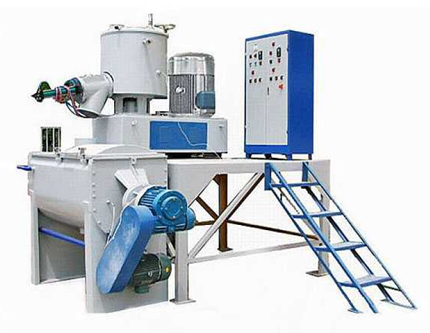
In the processing of PVC (polyvinyl chloride), mixing technology is the first crucial step in the production of PVC products and plays a vital role. However, many companies often overlook this step, and workers tend to misunderstand the mixing process, thinking that mixing is simply stirring all components of the formulation evenly. In fact, mixing technology is far more complex than that. This article will detail the role, principles, and processes of PVC mixing.
1. Basic Principles of Mixing
PVC products are composed of PVC resin, stabilizers, modifiers, processing aids, fillers, colorants, and various additives. The main purpose of mixing is to blend these raw materials uniformly to form a dry blend with high bulk density, good flowability, and dry looseness, ensuring it is suitable for subsequent processing.
2. Mixing Process: Key Points of Hot and Cold Mixing
The core process of PVC mixing consists of two steps:
hot mixing and cold mixing.
Among them, hot mixing is the key to the quality of the mixture.
The following details the key aspects of the hot mixing process:
2.1 Hot Mixing: The Key Step to "Heating Up" the Materials
Hot mixing involves the use of high-speed mixers where friction and collision among materials generate heat, causing the material to rise in temperature and mix evenly. This process directly affects the final product quality through specific functions, parameter controls, and operational details.
2.1.1 Purpose of Hot Mixing
The core goal of hot mixing is to make the material "uniform and stable", including:
- Preliminary plastification (gelation): Low melting point additives (e.g., lubricants) melt and coat the PVC particles, transforming them from scattered solid particles into a partially gelled uniform state.
- Increased bulk density and improved flowability: After mixing, the bulk density of the material increases, similar to how dry sand turns into damp sand, making it easier to transport and improving extrusion efficiency.
- Removal of moisture and low-volatility components: At around 100°C, moisture and low-volatility substances (like small molecular impurities in additives) evaporate, avoiding bubbles and pinholes in the final product.
- Improved preliminary gelation and dispersion: PVC particles of varying sizes merge into uniform larger particles with semi-transparent edges (partially gelled), resulting in better uniformity and avoiding uneven plastification during extrusion.
2.1.2 Key Parameters: Temperature, Time, Feeding Sequence
These three parameters are critical in hot mixing. Any error could lead to mixing failure.
- Final Temperature (110–120°C): Too low, moisture and volatiles remain; too high, PVC may degrade or burn (scorch), consuming excessive stabilizer.
- Special case: For formulas with high calcium carbonate content, a slightly higher temperature (e.g., 125°C) helps PVC better "adsorb" the filler.
- Mixing Time (7–12 min recommended):
If too short, materials may not be uniformly mixed or may lump;
If too long, the material may not reach the desired temperature, indicating equipment issues.
- Feeding Order (Temperature-Stepped): Components are added in stages:
1. First, PVC resin and stabilizer (to avoid burning).
2. At 60°C, add impact modifiers, processing aids, and internal lubricants.
3. At 80°C, add fillers (e.g., CaCO₃), pigments (e.g., TiO₂), external lubricants, and antioxidants.
2.1.3 Hidden Details: Loading Volume and Equipment Condition
- Loading per batch: 75% of tank capacity is optimal. Too little quantity leads to poor heating; too much causes uneven mixing and localized overheating.
- Equipment needs regular checks: Worn paddles reduce mixing efficiency; inaccurate thermometers mislead temperature judgments.
2.2 Cold Mixing: The Cooling and Stabilizing Step
Cold mixing follows hot mixing and involves cooling the material. Though not requiring precise high-temperature control, it directly impacts material storage stability and downstream processing.
2.2.1 Principle: Rapid Cooling with Water
Cold mixers are large containers with cooling jackets where circulating water removes heat as the materials tumble inside, transferring heat to the water.
2.2.2 Why Cold Mixing is Necessary
- Prevent Material Degradation: Without cooling, high temperatures degrade PVC and consume stabilizers, leading to brittleness and discoloration.
- Prevent Reabsorption of Moisture: Natural cooling under normal temperature leads to reabsorption of moisture from the air, causing defects like bubbles during extrusion.
2.2.3 Key Parameters
- Discharge Temperature: Should be cooled to around 40°C. Too high, material may still degrade; too low, wastes energy.
- Cooling Water Temperature: 13–15°C is ideal for balancing efficiency and cost.
Conclusion
PVC mixing is a critical step in PVC processing. A thorough understanding of its function, principles, and process can optimize production, significantly improving product quality and manufacturing efficiency.
THE END